Moving a Giant
The logistics of excavating (挖掘) and relocating a town's century﹣old, living sequoia (红杉) tree. Inhabitants of Boise, Idaho, watched with trepidation earlier this year as the city's oldest, tallest resident moved two blocks. The 105﹣year﹣old sequoia tree serves as a local landmark, not only for its longevity but also because renowned naturalist and Sierra Club cofounder John Muir provided the original seedling. So, when Saint Luke's Health System found that the 10﹣story﹣tall conifer (针叶树) stood in the way ofits planned hospital expansion, officials called tree﹣moving firm Environmental Design.
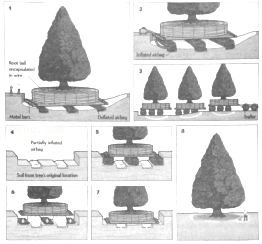
The Texas﹣based company has developed and patented scooping and lifting technology to move missive trees. Weighing in at more than 800,000 pounds, the Boise sequoia is its largest undertaking yet. "I(had) lost enough sleep over this," says David Cox, the company's Western region vice president and that was before the hospital mentioned the tree's distinguished origin. Before the heavy lifting began, the team assessed the root system and dug a five﹣foot﹣deep cylinder, measuring 40 feet in diameter, around the trunk to protect all essential roots. After encapsulating the root ball in wire mesh, the movers allowed the tree to adapt to its new situation for seven months before relocating it. The illustration details what followed.﹣﹣Leslie Nemo
1. Mark A. Merit and his team at Environmental Design installed underneath the root ball a platform of seven﹣inch﹣diameter, 44﹣foot﹣long steelbars and, just below the rods, a first set of uninflated airbags (shown in gray). The team also dug a shallow ramp.
2. In roughly 15 minutes, the movers inflated the airbags to about three feet in diameter to raise the root ball to the surface of the hole.
3. By underinflating the front bags, the team allowed the platform carrying the tree to roll up the ramp and out of the hole while staying level. A trailer hauled the tree along as team members removed the airbags from the back of the platform and replaced them in the front. They repeated the process until the tree arrived at the edge of its new home.
4. There a second set of partially inflated bags (shown in white) waited inside the hole. Soil surrounding the sequoia in its original location was relocated as well, because trees are more likely to survive a transplant when they move with their original soil.
5. Using the first set of airbags, the movers rolled the platform into the new hole.
6. The bags waiting there were then inflated further to take the weight of the sequoia while the transportation bags were deflated and removed from under the tree.
7. The white bags were then deflated in about half an hour to lower the sequoia's root ball to the bottom of its hole. The bags were removed, but the metal bars were left with the tree because they rust and degrade over a number of years.
8. For the next five years the local park service will monitor and maintain the tree in its new home.
(1)Which of the following words can be used to replace the words underlined "stood in the way of"?
| A. |
Resisted. |
| B. |
Balanced. |
| C. |
Blocked. |
| D. |
Promoted. |
(2)What is the reason for the relocation of Sequoia trees?
| A. |
Because the Scooping and lifting technology should be put into use. |
| B. |
Because it blocks local hospital expansion plans. |
| C. |
Because it corresponds to government's plan of Environmental Design. |
| D. |
Because sequoia trees are over a hundred years old. |
(3)How will the migrated sequoia trees be dealt with?
| A. |
They will be given new soil in the new living environment. |
| B. |
Metal rods used to move sequoia trees will not be left on the trees. |
| C. |
They will be kept in transport bags all the time. |
| D. |
They will be managed by specialists in the next five years. |
Bitcoin and other so﹣called cryptocurrenciest (加密货币) have been all over the news lately. Apparently, the idea of money that's not tied to a specific bank or a specific country is appealing to many. But it's worth remembering that the banking system that we now all live with is just that: A modern invention. Not so long ago, money was almost always created and used locally, and bartering was common. (In fact, it still is common among many online local networks, like the Buy Nothing Project.).
In the past, money's makeup varied from place to place, depending on what was considered valuable there. So while some of the world's first coins were made from a naturally occurring hybrid of gold and silver called electrum (金银矿), objects other than coins have served as currency, including beads, ivory, livestock, and cowrie shells. In West Africa, bracelets of bronze or copper were used as cash, especially if the transaction was associated with the slave trade there. Throughout the colonial period, tobacco was used to replace coins or paper bills in Virginia, Maryland and North Carolina, even though it was used elsewhere in the colonies and extensively throughout Europe and the U. K.
Today, on an island in the Pacific, a specific type of shell still serves as currency and some people there are even hoarding (储存) it, just like Bitcoin moguls, convinced that one day, it will make them wealthy beyond imagination. On Malaita, the most﹣populated island that's part of the Solomon Islands, shells are accepted at most places in exchange for goods.
"How much tuna (金枪鱼) you can get for your shells depends on their color and shape," Mary Bruno, a shop owner from the small town of Auki, on Malaita, told Vice. "One strip of darker shells might get you about two cans of smaller tuna, but the red ones are worth more. For the red ones, one strip might get enough tuna to feed a big family for a long time."
Just like a mintthat creates coins, there's only one place on the island where the shells, which are polished and strung together to form 3﹣foot﹣long ropes, are made. The strips of red, white, and black shells all come from Langa Langa Lagoon, where artificial islands were long﹣ago built by locals to escape from the island﹣dwelling cannibals. Once marooned (困住) out on their islands, locals needed a currency to use among themselves, and so the shell currency was born.
Using shells for money was common throughout the Pacific islands as late as the early 1900s, but Malaita is unique in that they are still used today. And just like cryptocurencies, there are those who think the islanders are smart to invest in this type of money, which is reported to have risen in value over the last three decades. It might seem strange to hoard a bunch of processed, strung﹣together shells, but what is a pile of dollars? Just a specially printed piece of paper and hemp that we've assigned value to and probably less durable over time than those shells.
(1)According to the passage, which of the following is TRUE?
| A. |
Money was created and was widely used in the world. |
| B. |
Tobacco was used as coins or paper bills in American in the past. |
| C. |
The ingredients of world's first coins may be the combination of gold and silver. |
| D. |
Using shells for money has been out of date in the world. |
(2)The word "mint" in paragraph 5 is closest in the meaning to " ".
| A. |
a kind of money that can exchange |
| B. |
the leaves of a mint plant used fresh or candied |
| C. |
a place to produce and polish shells |
| D. |
a factory that produces currency |
(3)What's opinion of the author towards shells for money?
| A. |
Reasonable. |
| B. |
Imaginary. |
| C. |
Convenient. |
| D. |
Inventive |
(4)Which of the following might be the best title of the passage?
| A. |
The History of Biteoin |
| B. |
Shells Still Money |
| C. |
The Currency Is of Great Use |
| D. |
Some Shells |
When 17﹣year﹣old Quattro Musser hangs out with friends, they don't drink beer or cruise around in cars with their dates.(1) , they stick to G﹣rated activities such as rock﹣climbing or talking about books.
They are in good company, according to a new study showing that teenagers are increasingly delaying activities that had long been seen as rites of passage into (2) . The study, published Tuesday in the journal Child Development, found that the percentage of adolescents in the U. S. who have a driver's license, who have tried alcohol, who date, and who work for pay has plummeted since 1976, with the most precipitous (急剧的)(3) in the past decade. The declines appeared across race, geographic, and socioeconomic lines, and in rural, urban, and suburban areas.
To be sure, more than half of teens still engage in these activities, but the (4) have slimmed considerably. Teens have also reported a steady decline in sexual activity in recent decades, as the portion of high school students who have had sex fell from 54 percent in 1991 to 41 percent in 2015, according to Centers for Disease Control statistics. "People say,'Oh, it's because teenagers are more responsible, or more lazy, or more boring,' but they're (5) the larger trend," said Jean Twenge, lead author of the study, which drew on seven large time﹣lag surveys of Americans. Rather, she said, kids may be less (6) in activities such as dating, driving or getting jobs because in today's society, they no longer need to.
According to an evolutionary psychology theory that a person's "life strategy" slows down or speeds up depending on his or her (7) , exposure to a "harsh and unpredictable" environment leads to faster development, while a more resource﹣rich and secure environment has the (8) effect, the study said. In the first (9) , "You'd have a lot of kids and be in survival mode, start having kids young, expect your kids will have kids young, and expect that there will be more (10) and fewer resources," said Twenge, a psychology professor at San Diego State University who is the author of "iGen: Why Today's Super﹣Connected Kids Are Growing Up Less Rebellious, More Tolerant, Less Happy﹣and Completely Unprepared for Adulthood."
In that model a teenage boy might be thinking more (11) about marriage, and driving a car and working for pay would be important for "establishing mate value based on procurement of resources," the study said. But America is shifting more toward the (12) model, and the change is apparent across the socioeconomic spectrum, Twenge said. "Even in families whose parents didn't have a college education…families are smaller, and the idea that children need to be carefully (13) has really sunk in." The (14) of "adult activities" could not be attributed to more homework or extracurricular activities, the study said, noting that teens today spend fewer hours on homework and the same amount of time on extracurriculars as they did in the 1990s (with the exception of community service, which has risen slightly). Nor could the use of smart phones and the Internet be entirely the (15) , the report said, since the decline began before they were widely available. If the delay is to make room for creative exploration and forming better social and emotional connections, it is a good thing, he said.
|
(1)A. Therefore |
B. Rather |
C. Moreover |
D. Besides |
|
(2)A. childhood |
B.neighborhood |
C. adolescents |
D. adulthood |
|
(3)A. escapes |
B. ends |
C. decreases |
D. changes |
|
(4)A. minorities |
B. majorities |
C. masses |
D. amounts |
|
(5)A. taking |
B. avoiding |
C. sending |
D. missing |
|
(6)A. interested |
B. envied |
C. relieved |
D. realized |
|
(7)A. emotions |
B. surroundings |
C. customs |
D. habits |
|
(8)A. wrong |
B. same |
C. opposite |
D. similar |
|
(9)A. event |
B. issue |
C. case |
D. occasion |
|
(10)A. trouble |
B. questions |
C. benefits |
D. diseases |
|
(11)A. respectively |
B. delicately |
C. seriously |
D. considerably |
|
(12)A. slower |
B. better |
C. smaller |
D. faster |
|
(13)A. emphasized |
B. related |
C. organized |
D. educated |
|
(14)A. implement |
B. postponement |
C. achievement |
D. payment |
|
(15)A. cause |
B. impact |
C. fact |
D. result |
|
A. committed B. compared C. contact D. delegation E. destructive F. humbleG. negotiate H. respelled I. similarityJ. superiors K. witnessed |
Some Very "American" Words Come from Chinese
Many of the Chinese words that are now part of English were borrowed long ago. They are most often from Cantonese (粤语) or other Chinese languages rather than Mandarin. Let's start with them.
kowtow
The English word kowtow is a verb that means to agree too easily to do what someone else wants you to do, or to obey someone with power in a way that seems (1) . It comes from the Cantonese word kau tau, which means "knock your head". It refers to the act of kneeling and lowering one's head as a sign of respect to (2) such as emperors, elders and leaders. In the case of emperors, the act required the person to touch their head to the ground. Britain's Lord George Macartney refused to "kau tau" to the Qianlong Emperor. Soon after, the English word "kowtow" was born. In 1793, Britain's King George III sent Lord George Macartney and other trade ambassadors to China to (3) a trade agreement. The Chinese asked them to kowtow to the Qianlong Emperor. As the story goes, Lord Macartney refused for his (4) to do more than bend their knees. He said that was all they were required to do for their own king.
It is not surprising, then, that Macartney left China without negotiating the trade agreement. After that, critics used the word kowtow when anyone was too submissive to China. Today, the usage has no connection to China, nor any specific political connection.
gung﹣ho
Another borrowed word that came about through (5) between two nations is gung﹣ho. In English, the word gung﹣ho is an adjective that means extremely excited about doing something. The Chinese characters "gong" and "he" together mean "work together, cooperate." The original term gongyehezuoshe means Chinese Industrial Cooperatives. The organizations were established in the 1930s by Westerners in China to promote industrial and economic development. Lt. Colonel Evans Carlson of the United States Marine Corps observed these cooperatives while he was in China. He was impressed, saying "…all the soldiers (6) themselves to one idea and worked together to put that idea over." He then began using the term gung﹣ho in the Marine Corps to try to create the same spirit he had (7) . In 1942, he used the word as a training slogan for the 2nd Marine Raider Battalion during World War II. The men were often called the "Gung Ho Battalion." From then, the word gung﹣ho spread as a slogan throughout the Marine Corps. Today, its meaning has no relation to the military.
typhoon
In English, a typhoon is a very powerful and (8) storm that occurs around the China Sea and in the South Pacific. The word history of typhoon had a far less direct path to the English language than gung﹣ho. And not all historical accounts are the same. But, according to the Merriam﹣webster New Book of Word Histories, the first typhoons reported in the English language were in India and were called "touffons" or "tufans." The word tufan or al﹣tufan is Arabic and means violent storm or flood. The English came across this word in India and borrowed it as touffon. Later, when English ships encountered violent storms in the China Sea, Englishmen learned the Cantonese word tai fung, which means "great wind." The word's (9) to touffon is only by chance. The modern form of the word typhoon was influenced by the Cantonese but (10) to make it appear more Greek.
A comprehensive study of 4,500 children conducted by the National Institutes of Health in 2018 shows that children who spent more than seven hours a day staring at screens showed evidence of premature thinning of their brain's cortex the outer layer that processes sensory information. "We don't know if it (1) (cause) by the screen time. We don't know yet if it's a bad thing. It won't be until we follow them over time (2) we will see if there are outcomes that are associated with the differences that we're seeing in this single snapshot," Dr. Gaya Dowling. "What we can say is that this is(3) the brains look like of kids who spend a lot of time on screens. And it's not just one pattern."
The problem isn't just screens (4) , but also the way screens tempt kids (and adults) away from something far more important: physical activity. More than 23 percent of adults and 80 percent of adolescents don't get enough physical activity, and according to a 2019 report from the World Health Organization (WHO), these patterns of activity and rest arise (5) habits we develop early in life. "What we really need to do is (6) (bring) back play for children," says Dr. Juana Willumsen, a WHO specialist in childhood obesity and physical activity, in a statement about new WHO guidelines issued in April 2019. "This is about making the shift from sedentary time to playtime, while (7) (protect) sleep." Of course, children aren't completely to blame for their screen addiction.
Sometimes, the parents (8) complain about the role of screens in family life are just as guilty of spending too much time in front of one. A 2016 study (9) (conduct) by Common Sense Media found that parents spend up to nine hours a day in front of screens, mostly not for work﹣related reasons. While 78 percent of parents said they believed they were good screen time role models, the study found a disconnect between their behavior and their perception of their behavior. Parents need to limit screen time for themselves and especially for their kids(10) it means playing the bad guy. Our mental and physical health depends on it.
Direction: Write an English composition in 120﹣150 words according to the instructions given below in Chinese.
你是※※中学的※※,你校学生会组织一次徒步活动,已在校园网发布方案,征求师生的修改意见.你需要写一封邮件,包括以下两点:
1. 提出你觉得需要改进的地方;
2. 需要改进的原因.
|
主题 |
发现上海 |
|
时间 |
5月1日(周日)下午3点 |
|
路线 |
从人民广场出发,途径南京东路,到达外滩(the Bund),全程徒步,之后再徒步原路返回人民广场. |
Directions: Read the following passage. Summarize the main idea and the main point(s) of the passage in no more than 60 words. Use your own words as far as possible.
Learning by Rote in the Digital Age
Rote learning has become seen as an outdated method of teaching. The dictionary defines learning 'by rote' as:'from memory, without thought of the meaning: in a mechanical way'.
The decline of rote learning has been quickened by technology. No one needs to memorize friends' phone numbers or email addresses because such data is conveniently stored and accessible electronically. And why remember when and where World War Two broke out when you can find the answer on the Internet in about 6 seconds? But now there are voices for a need to return to rote learning.
In fact, memorizing key data is essential to learning any skill. Doctoring requires knowledge of medicine and lawyering requires knowledge of cases and laws. Of course, being able to recall things will not further your understanding of those things, but without memorizing these foundation elements, you cannot progress to a deeper understanding of a subject.
While the Internet and computers have weakened the need for us 10 remember things, it may well be that mobile learning can help bring this style of learning back to life by making it more convenient and more fun.
Drilling yourself with flashcards or by repetition is usually hard and boring work, which is why most people need their multiplication tables to be drilled into them by teachers or parents. Rote learning without a willing third party can be a battle of discipline and motivation. But mobile learning can make those flashcards and drills more appropriate to individual study; our digital devices can challenge and inform us at the same time and also keep us motivated, whether through game﹣like structures or recording our progress.
Once you've acquired the essentials of a subject by rote learning, you will find it easier to go deeper in the application of knowledge which is important.
|
A. Clear solutions already exist for reducing greenhouse gas emissions. B. Despite this, how our dietary choices affect climate change is often underestimated. C. Food, especially livestock, also lakes up a lot of room D. In developed countries, vegetarianism would bring all sorts of environmental and health benefits. E. No matter how much their carnivorous friends might deny it, vegetarians have a point: cutting out meat delivers multiple benefits. F. Though a relatively small increase in agricultural land, this would more than make up for the loss of meat. |
W hat would happen if the world suddenly went vegetarian?
People become vegetarians for a variety of reasons. Some do it to make animal suffering, others because they want to pursue a healthier lifestyle. Still others are fans of sustainability or wish to reduce greenhouse gas emissions. (1) And the more who make the switch, the more those perks would manifest on a global scale.
Jarvis and other experts at Colombia's International Centre for Tropical Agriculture carried out researches to see what might happen if meat dropped off the planet's menu overnight.
First they examined climate change. Food production accounts for one﹣quarter to one﹣third of all greenhouse gas emissions from human activities worldwide, and the worst of responsibility for those numbers falls to the livestock industry. (2) In the US, for example, an average family of four emits more greenhouse gases because of the meat they eat than from driving two cars but it is cars, not steaks, that regularly come up in discussions about global warming.
(3) Of the world's approximately 12 billion acres of agricultural land, 68% is used for livestock. Should we all go vegetarian, ideally we would give at least 80% of that pastureland (牧场) to the restoration of grasslands and forests, which would capture carbon and further alleviate climate change.
The remaining 10 to 20% of former pastureland could be used for growing more crops to fill gaps in the food supply.(4) That's because one﹣third of the land currently used for crops is dedicated to producing food for livestock not for humans.
There are classes for the mothers of babies, but there's no helping with your mum and dad growing old.
Old people's wards are hell for old people. Geriatric wards are bedlam and bonkers. A toothless woman screaming when left alone, a cry that reaches the high hospital ceiling. A woman effing and blinding ﹣ the polite curtain will not protect her from the indignity of a happy change. A woman who lives the same moment in repeat, dressed up for going home in a bright red, over the dressing grown, asking for the key to her house, saying over and over: "Am I going home today?"
And though my mum, by the time she was released, knew that her life was charmed compared with the lives of the world's refugees. It seems to me as if the plight (困境) of old people, while not as horrible as the plight of refugees, shares some of the horror. Just as we live in a society that hasn't caught up with technology, the kind of moral choices it gives people, we also live in a world that hasn't kept up with its ageing population. We have the advances in medical science and technology that have kept people alive longer, but not the advances in how to treat our ageing population. Society is lagging behind the old, failing and falling.
There are certain small but piercing similarities between the treatment of the old and the treatment of refugees. The old are often displaced from their homes, moved out against their will; decisions are often made for them that they have no say over. Often, they are treated as fools or halfwits, crowded together in one place, given clothes that don't belong to them, treated as a fallen tribe, incapable of any individuality. Nobody imagined my mother was a secretary of the Scottish peace movement, a primary teacher, a lifelong socialist, a witty woman. Out of hospital, my 85﹣year﹣old mum said: "going into hospital at my age puts years on you. God save from old people's wards. You never think of yourself as old. You look across the ward and think, am I like that?"
(1)The treatment of the old is compared of that of the refugees in order to .
| A. |
prove they have a lot in common |
| B. |
show the terrible status of the old |
| C. |
display their similarities and differences |
| D. |
indicate that old people have to leave their home |
(2)What can be inferred from the passage?
| A. |
Refugees lead a better life than old male patients. |
| B. |
Old people are ill﹣treated due to their loss of individuality. |
| C. |
The author's mom is capable of teaching and being a socialist in the meanwhile. |
| D. |
The treatment of the ageing population doesn't develop as science advances. |
(3)The author's mom felt that life in the hospital .
| A. |
made her much older. |
| B. |
created her a mature woman. |
| C. |
enable her to look back at life. |
| D. |
let her full of gratitude to children. |
(4)The passage mainly discussed .
| A. |
the life of refugees and old people. |
| B. |
social responsibility to old women. |
| C. |
improper treatment of old people. |
| D. |
preparing for ageing parents. |
American Airlines
Date of Issue: 233 JAN 10
Ping Luo:
Thank you for choosing American Airlines/American Eagle, a member of the one world TMAlliance. Below is your journey plan for the ticket(s) purchased. Please print and keep possession of this document for use throughout your trip.
Record locator: HPMDLH
You may check in and obtain your boarding pass for U.S. domestic electronic tickets within 24 hours of your flight time online at AA. Come by using www.aa.com/ checkin or at a Self﹣Service Check﹣In machine at the airport. For faster check﹣in at the airport, scan the barcode at any AA Self﹣Service machine.
Effective February 1, American Airlines will be cashless onboard all flights. For in﹣flight purchases, we will accept Citi®/A Advantage®MasterCard® and other major credit or debit cards only. Cashless cabins will not be implemented onboard American Eagle and American Connection flights …only cash will continue to be accepted onboard those flights.
e Ticket
|
Carrier |
Flight number |
Departing |
Arriving |
Booking Code |
|||||
|
City |
Date & time |
City |
Time |
||||||
|
American Airlines |
4290 |
NASHVILLE |
SUN, 31 JAN 11:05 AM |
CHICAGO OHARE |
12:40 PM |
Q |
|||
|
OPERATED BY AMERICAN EAGLE |
|||||||||
|
Ping Luo |
Economy |
Seats 9C |
Food for Purchase |
||||||
|
American Airline |
4131 |
CHICAGO OHARE |
SUN 31 JAN 2:40 TM |
MADISON |
3:25 PM |
Q |
|||
|
OPERATED BY AMERICAN EAGLE |
|||||||||
|
Ping Luo |
Economy |
Seats 17C |
Food for Purchase |
||||||
(1)The above document serves as .
| A. |
evidence of booked tickets. |
| B. |
explanations of check﹣in policies. |
| C. |
a reminder of airline regulations. |
| D. |
an airline ticket and its confirmation. |
(2)During his journey, Ping Luo will .
| A. |
fly non﹣stop to his destination. |
| B. |
arrive in Chicago in the late afternoon of the same day. |
| C. |
have to stay at CHICAGO OHARE airport for two hours. |
| D. |
reach his final destination on the next day. |
(3)According to the document, in order to check in at the airport faster, a passenger may .
| A. |
arrive at the airport far ahead of time. |
| B. |
choose the seat in advance. |
| C. |
use a self﹣service machine. |
| D. |
contact the record locator online. |
The adaptation of books to the big screen is nothing new to our society. Books have become well﹣respected tools for creating a better Hollywood. However, films should be just as respected for their ability to create better writers.
The main skill films help writers develop is attention to progress. Most directors and screenwriters know that the majority of people are not willing to sit through a five﹣hour film. Thus, every scene must have a purpose. This is a vital objective to keep in mind when writing a novel or short story. With most writing courses placing emphasis on literary techniques, it is easy to become more invested in diction than with actually moving the plot forward. Films remind the writer that while a novel ought to have some degree of literary complexity, the goal at the end of each chapter, page, or sentence is simple: keep the story moving. Films not only help writers develop a plot, but also help writers develop specific moments within their stories. Although writing a means of expression, not all things are easy to express in writing, especially facial expressions and emotions. Films allow writers to study the bodily and emotional actions that make characters read more realistically and make stories more tempting.
Lastly, sometimes it takes a film to bring about a story idea in the first place. Stop using a horribly specific or extremely uninteresting prompt. A pleasing theme or aesthetic can be enough to inspire a character or setting. As writers, whether fiction or independent, our works often arise from the things we see around us or the things we wish we could see. Nonetheless, our works also arise from the visuals that have been created for us. As literature continues to enter the film industry, perhaps we should make use of film techniques in our literature.
(1)Reminded by films, a writer can move the plot forward by .
| A. |
keeping in mind that every word should mean something. |
| B. |
providing a description of as many details as possible. |
| C. |
paying attention to further enhancing literary complexity. |
| D. |
choosing the perfect word to go with his/her thought. |
(2)According to the passage, films help writers develop in many aspects except .
| A. |
getting an improved expressiveness |
| B. |
focusing on keeping the story moving. |
| C. |
complicating their thinking and life. |
| D. |
bringing in inspiration for new works. |
(3)The word "prompt" (paragraph 4)probably means .
| A. |
a reason to write. |
| B. |
a topic to start from. |
| C. |
an excuse to put off working. |
| D. |
an element to attract relationship. |
(4)Which of the following statements best represents the author's thoughts in this passage?
| A. |
book writers are the ones promoting the growth of the film industry. |
| B. |
directors and screenwriters are more respected than fiction writers. |
| C. |
writers should spend more time on wording rather than on other things. |
| D. |
filmmaking technique could help book writers to improve themselves. |
试题篮
() 粤公网安备 44130202000953号